Validate IDEA STAGE
Is it just you, and has anyone already built it? Saibyl checks the trademark and patent record first, then puts the idea in front of a room.
Saibyl builds a room of AI buyers from your own material: your deck, your site, or just five answers — pitches them, and hands you every objection the room raised, with the exact sentences behind it. Rehearse the launch. Fix what fails. Then go.
Every number Saibyl reports opens into the sentences it came from. The room argues in written threads. Nothing is ever posted anywhere real.
AI buyers in the largest rooms
30 in your first free run
places where the room argues
up to 6 in a single run
stages of the company
idea to raise, one platform
Every stage of the company asks a different question. Saibyl answers each one with evidence, and the next answer is always one run away.
Start at your stage →Is it just you, and has anyone already built it? Saibyl checks the trademark and patent record first, then puts the idea in front of a room.
Which objections kill the pitch, and which answers actually move them. Test the fix on the same room, and watch the delta.
Up to eight versions of the message, head to head, in front of the same room. The winner earns your budget.
Pricing moves, feature drops, expansion pitches, rehearsed before the market grades them.
How the story reads to investors, and the questions you'll be asked, before you're in the room that matters.
We built a sample product, Tallyhook, invoice chasing for freelancers, and put it through a full run, so you can inspect real output before you upload a word.
The loudest were about client relationships. That is the lesson founders usually learn after launch. This room surfaced it in about an hour, before.
Every row opens into the exact sentences behind it, and who said them. That's the standard for everything Saibyl reports: no score you take on faith, no chart without a receipt.
Run yours →EVERY BUYER IN A SAIBYL ROOM IS AI, BUILT FROM YOUR MATERIAL, LABELED SYNTHETIC ON EVERY SCREEN.
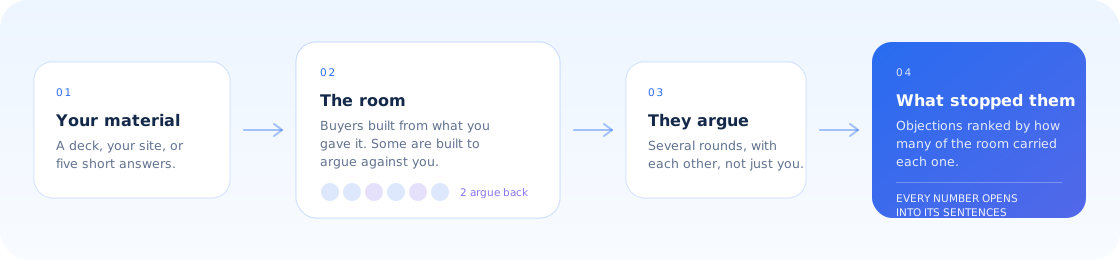
Name the thing you're selling. One line is enough. Every room, run, and result attaches to it.
Your deck, your site, a rival's pricing page, or just answer five short questions.
DECK · SITE · 5 ANSWERSWho buys this and why we think so. Adjust anything, or approve it and run.
The room argues over your pitch in written threads. Nothing is posted anywhere real. You watch it live.
Ranked, grouped, and each one opens into the sentences behind it.
RANKED · WITH RECEIPTSThe free run answers the first two questions. Each one after that turns the last answer into the next advantage, and each is priced on its own, so you only buy the ones you want.
Who reacts to this?
Built from your material, not picked from a list. You approve it before anything runs.
What do they object to?
The room argues with your pitch, and with each other. The pushback arrives ranked, with receipts.
Did my reply work?
Saibyl drafts a reply to each objection worth answering, runs the same room again, and shows whether it moved.
Which real companies match?
The audience you approved becomes a list of real companies that fit it, each with the source shown.
Which version wins?
Up to eight versions of the same message in front of the same room at the same moment, so what differs is the wording, never the crowd. The winner earns the budget; the rest never cost you a campaign.
Not our figures. Three published ones, each linked to the study it came from, because a number on a marketing page that you cannot check is not evidence.
43%
die of the wrong message
of startups that shut down cite poor product-market fit — the second most common reason after running out of money, which the same study calls the final cause rather than the root one.
CB Insights, analysis of 431 VC-backed companies that shut down since 2023 (385 with a stated reason) ↗$26.8bn
lost before anyone reads it
in global media value is lost every year to programmatic inefficiency — before anyone has read a word of your message.
Association of National Advertisers, Q2 2025 Programmatic Transparency Benchmark ↗56.7%
reaches a real person
is the share of programmatic spend that reaches a qualified impression even for advertisers running disciplined quality controls. The rest of the budget is spent before the message is tested at all.
Association of National Advertisers, Q4 2025 Programmatic Transparency Benchmark ↗Nobody has run that study on Saibyl, and we are not going to imply otherwise. Here is what is known about the method, what we can prove about our own output, and what a run will never tell you.
85%
as accurate as people are about themselves
Stanford built agents from interviews with 1,052 real people. On the General Social Survey, the agents replicated each person’s answers 85% as accurately as that person replicated their own answers two weeks later.
Park et al., arXiv:2411.10109 ↗90%
of human test-retest reliability
PyMC Labs and Colgate-Palmolive ran 57 real product surveys against 9,300 human responses. Synthetic panels matched real purchase intent at 90% of the reliability humans manage against themselves.
Maier et al., arXiv:2510.08338 ↗0
variance, on the half we count
Our own measurement. Five sites, scored twice, five minutes apart, pages unchanged. The counted half of a website check returned identical results every time. Reproducibility is not accuracy, but nothing is accurate without it.
Saibyl, 26 August 2026What a run will not tell you, printed on every report
These are not a disclaimer at the bottom of a page. They are in the code that plans every report, and they print inside the results you buy.
Your first run is free, and after that a full run costs about $15. There is no subscription: you buy credits when you want them, they never expire, and every run shows its exact price before it starts.
| What you run | Credits | Cost |
|---|---|---|
| Your first run 30 buyers, 3 rounds, 2 places | 1,335 | Free |
| A full run 100 buyers, 5 rounds | 3,014 | $15.07 |
| Website check six reviewers read your page | 1,750 | $8.75 |
| Rewrite and re-score the page, tested on the same room | 5,000 | $25.00 |
| What to say back an answer to each objection | 1,500 | $7.50 |
| Name check is the trademark taken | 0 | Free |
| Prior-art search patents, with claim deep-reads | 2,000 | $10.00 |
| Full patent landscape assignees, continuity, examiners | 6,000 | $30.00 |
| Real companies that match with the evidence they match | 3,000 | $15.00 |
$1 buys 200 credits, and a credit never expires. Top up between $10 and $500 whenever you want, in one payment. Nothing renews, nothing expires, and no card is taken at signup. A bigger room or more rounds costs proportionally more, and you always see the exact price before you press go. Running this across a lot of clients? Talk to us.
Into building your audience, and nowhere else. Your uploads never train models, are never visible outside your account, and you can delete them any time. The full policy is linked below.
No, and that is the point. Each is an AI given a specific role, what they already use, and what would make them doubt you, all drawn from your own material. What comes back is what people in that position tend to say and object to: a rehearsal you can run in an hour, at every stage, as many times as the decision deserves.
Then you're exactly who the first stage is for. Answer five short questions: the problem, who has it, what you're building, what they use today, a rough price — and Saibyl builds your room from those. They're also the five questions every investor will ask you, so the hour pays twice.
You'll have your audience and your objection list, and a specific, quantified question the next stage answers. After that you buy credits when you want them: $1 buys 200 credits, a full 100-buyer run is about $15, and top-ups run from $10 to $500. No card is ever taken at signup, so nothing charges you until you decide.
No. There are no plans and no monthly fee. You top up credits as you go and they never expire. Nothing renews, so there is nothing to cancel. Every run is priced before it starts, and you spend against a balance you chose to buy.
No. The room is built to argue. A share of every audience is constructed specifically to push back before it has seen your pitch, with its lean set by what those buyers already use and would have to rip out, not by anything you wrote. Every run reports how many of those people were in the room and what the score was with and without them. In Saibyl's own test of itself, the harshest room returned zero support for the pitch.
One model answering as "a buyer" gives you one voice, agreeable by default, with nothing behind it. Saibyl builds a room of buyers from your own material, gives each one a role, an incumbent tool and a reason to doubt you, and lets them argue over several rounds, then ranks the objections by how much of the room actually carried each one and opens every number into the sentences it came from.
One complete run, free. Your room is built from your material, your objections arrive with receipts, and your next move stops being a guess.
Start your first run →